

Quick Win: The Fix That Delivers More Leads in 30 Days
Most B2B websites hide their lead capture forms where no one will find them. The fastest way to change that is simple: put your form in the hero section and tie it to ROI.
Here’s how it plays out in real life:
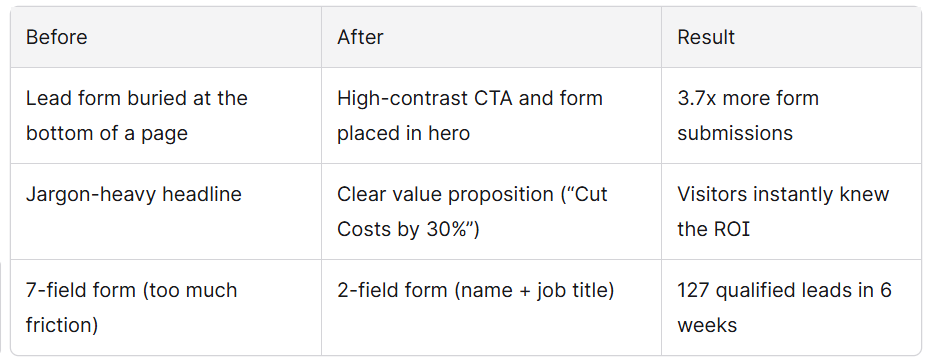
Do this now:
- Move your lead capture to the hero section.
- Use a sharp, ROI-driven value proposition.
- Keep the form to 2–3 fields max.
This single change can convert leads faster than any ad spend increase.
Why Most B2B Websites Fail at Lead Generation
Most b2b websites look polished and bring in steady website traffic, but I keep hearing the same question from the sales team: “Where are the leads?” The issue isn’t traffic; it’s a weak conversion structure. Without the right design, a site is just a brochure. In this guide, I’ll share the best practices I use to turn visitors into pipeline, complete with frameworks, examples, and KPIs you can apply right away.
Main Insights: What Separates Winners from Losers
Once the quick win is in place, you need a stronger system. These four patterns decide whether a b2b website becomes a growth engine or stays a static showcase:
- A Clear Value Proposition Always Wins
- Visitors should know in five seconds who you help and what ROI you deliver.
- Example: Simplifying a headline to “Cut Procurement Costs by 37% in 90 Days” doubled engagement.Pro Tip: Rewrite your headline until your target audience gets it instantly.
- Social Proof is the Shortcut to Trust
- Potential customers want proof others like them have succeeded with you.
- Add customer testimonials, client logos, and success stories near CTAs.
- Example: Adding three video testimonials increased conversion rates by 47%.Case Study: A fintech brand used quotes from satisfied customers on product pages, lifting conversions by 2.8%.
- Optimize for Mobile Devices and Responsiveness
- More than half of B2B mobile traffic comes from executives on phones.
- A weak current website design costs credibility and conversions.
- Responsive design across devices improves click through rates and conversion rates. KPI to Track: In google analytics, check mobile vs desktop bounce. If mobile is 20% higher, fix your b2b website design.
- Content Strategy Drives Pipeline, Not Just Traffic
- Align site content to the buyer’s journey.
- Early stage: blogs and white papers. Mid stage: case studies and calculators. Late stage: pricing and demos.
- This buyer-centric approach increases form submissions and creates qualified leads. Ready-to-Copy Callout: Map 3 buyer personas. Create one blog, one case study, and one CTA for each stage of their buying process.

Essential Elements of High-Performing B2B Website Design
A b2b website is not just about aesthetics. It is about conversion architecture. From what I have seen, the most effective sites consistently build around a few essential elements that drive ROI.
Homepage Design That Works Like a Sales Rep
Your homepage design is usually the first impression. Treat it like your best-performing rep. That means:
- Clear value proposition above the fold.
- Direct CTA tied to ROI.
- Trust layers, including social proof such as client logos and testimonials.
- Easy navigation to key pages like product, pricing, and case studies.
Pro Tip: In most audits, I find the homepage has five competing CTAs. Cut it down to one or two. Clarity beats clutter.
Product Pages That Convert Leads into Pipeline
Most product pages in B2B act like technical spec sheets. That misses the point. Buyers care about outcomes, not features.
A strong b2b website design turns product pages into conversion engines by:
- Showing ROI-focused use cases.
- Including social proof in the form of customer testimonials and metrics.
- Adding form submissions or chat triggers so you can convert leads right there.
Landing Pages Built to Maximize Conversions
Dedicated landing pages outperform generic pages every time. Use them for campaigns, ads, and specific buyer personas.
Key elements of a winning landing page:
- Focused value proposition tied to one pain point.
- Clear form submission with minimum fields.
- Strong visual appeal and high-quality images.
- Social proof placed directly near the CTA.
KPI to Track: Monitor track conversion rates per landing page in google analytics. Strong campaigns should hit 2–5% for cold traffic and 6–10% for warm traffic.

Advanced Tools and Emerging Trends
Technology has changed what a b2b website can do. The most effective teams use advanced tools to stay ahead.
- Progressive Web Apps (PWA): PWAs bring app-like speed and reliability to b2b websites. They improve user engagement on mobile devices by loading faster and working offline.
- Predictive Analytics: Using predictive analytics, companies can anticipate behavior and serve the right website content at the right stage of the buyer’s journey.
- Web Analytics: Tools like google analytics offer valuable insights on bounce rates, click through rates, and conversion funnels. Use them to test and refine your website’s performance.
Case Study Callout: One client used predictive analytics to personalize CTAs by company size. This lifted conversion rates by 39% in just eight weeks.
Contrarian Insight: Why Most Traffic Doesn’t Matter
Marketers often obsess over most traffic or vanity clicks. But I’ve seen sites with 50,000 visitors deliver fewer qualified leads than smaller sites with 5,000.
The difference is focus. Traffic without the right structure will not convert. A current website optimized for the buyer’s journey outperforms other sites that only chase search engines and search rankings.
Contrarian POV: Stop bragging about traffic growth. Celebrate when converting visitors into paying customers improves.
KPI Benchmarks for B2B Websites
If you cannot measure, you cannot improve. These are the benchmarks I use to evaluate b2b website effectiveness:
- Conversion Rates: At least 2–3% for cold campaigns, 6–10% for warm leads.
- Form Submissions: Minimum 20–30% completion for visitors who click a CTA.
- Click Through Rates: Over 3% for email campaigns leading to landing pages.
- User Engagement: At least 90 seconds average time on page for key pages.
- Website Goals: Every quarter, tie site content performance to pipeline value.
KPI to Track Callout: If existing customers visit your site but do not engage with valuable content, you are missing cross-sell and upsell revenue opportunities.

Best Design Practices That Drive Conversions
A b2b website design should never be based on guesswork. The sites that consistently deliver ROI follow clear design practices that align with buyer behavior.
Key Elements of Effective Web Design
Every b2b website that performs well shares a few key elements:
- A sharp value proposition stated in plain language.
- Clear navigation to key pages such as pricing, case studies, and product demos.
- Strong social proof placed near CTAs.
- A responsive design that adapts to mobile devices and desktops.
Pro Tip: Don’t overload your web pages with competing CTAs. Each page should guide visitors toward one action that supports your website goals.
Visual Appeal Without Clutter
Yes, design matters. But visual appeal must support clarity, not distract from it. Many b2b websites overuse animation and graphics. The result is slower load times and confused potential customers.
A better approach is careful use of high quality images, client logos, and data visuals that highlight ROI. Great design means prospects understand the value propositions faster and trust you more.
Content Strategy That Fuels the Buying Process
Traffic alone does not create revenue. A strong content strategy maps directly to the buyer’s journey and drives converting visitors into qualified leads.
- Top of Funnel: Blogs, guides, and white papers that solve obvious pain points.
- Mid Funnel: ROI calculators, case studies, and webinars that prove outcomes.
- Bottom of Funnel: Pricing clarity, demos, and comparison tools that help with the decision-making process.
Ready-to-Copy Callout: Write one piece of valuable content for each stage of the buyer’s journey. Then link them together so visitors always know the next step.
Framework: Funnel Gap Analysis™
Over time I’ve used a framework I call Funnel Gap Analysis™. It helps identify where a b2b website leaks leads.
- Traffic Stage: Look at organic traffic, mobile traffic, and referrals. Are you attracting the right buyer personas?
- Engagement Stage: Measure user engagement using google analytics. Are visitors staying long enough to read?
- Conversion Stage: Check form submissions, click through rates, and demo requests. What is the drop-off point?
- Revenue Stage: Align conversion rates with pipeline and paying customers.
KPI to Track Callout: If your conversion rates are below 2%, the issue is not always traffic. It may be a broken homepage design, poor content strategy, or lack of social proof.

Contrarian Insight: Stop Copying Other Sites
Too many companies benchmark their current website against competitors. They copy other sites without asking if those sites are actually performing.
The truth is, most b2b websites convert at just 1–2%. Copying them means copying failure. Instead, benchmark against data-driven performance:
- Conversion rates of 3–5% are achievable with CRO work.
- Click through rates above 3% are realistic for well-targeted campaigns.
- Website’s performance should be tied directly to lead and pipeline metrics, not just search rankings.
Contrarian POV: The goal is not to look like a competitor. The goal is to outperform them in ROI.
Buyer-Centric Design for Business Growth
A buyer centric approach is what separates the best b2b website design from the rest. Every part of the site should reflect how buyers actually think and make decisions.
- Map buyer personas to content and CTAs.
- Align site content with real pain points.
- Guide visitors from interest to decision with clear pathways.
This approach improves user engagement, maximizes conversions, and positions your site as a true centralized hub for business growth.
Case Study Callout: A logistics company rebuilt their new website around buyer personas. By addressing specific pain points and showing ROI calculators, they improved form submissions by 62% in one quarter.
Quick-Reference Summary:
If you only remember the essentials, let it be these:
- Homepage Design: Clear value proposition, one primary CTA, and visible social proof.
- Landing Pages: Focused content, strong visual appeal, and short form submissions for maximum conversion rates.
- Product Pages: Outcomes before features. Include ROI proof, client logos, and easy conversion triggers.
- Content Strategy: Map to the buyer’s journey with blogs, white papers, case studies, and pricing pages.
- Responsive Design: Ensure a seamless experience across mobile devices and desktop.
- Social Proof: Place customer testimonials, satisfied customers, and existing customers’ stories near CTAs.
- Web Analytics: Use google analytics and predictive analytics to uncover valuable insights and improve the website’s performance.
- Buyer-Centric Approach: Build for buyer personas, pain points, and the decision making process.
Key Elements Callout: A strong b2b website is built on clarity, trust, responsiveness, and measurable ROI.

Final Tips for CMOs and Growth Leaders
- Audit Your Current Website: Walk through it like a buyer. Do you understand the ROI in 5 seconds? If not, your value proposition needs work.
- Tie Website Goals to Revenue: Don’t just celebrate website traffic or search rankings. Track how the site delivers qualified leads, paying customers, and pipeline growth.
- Maximize Conversions First: Fix CTAs, homepage design, landing pages, and form submissions before investing in new traffic.
- Use Emerging Trends: Test progressive web apps for speed, predictive analytics for personalization, and web analytics to track real ROI.
- Leverage Existing Customers: Feature stories from satisfied customers. Use them as social proof to convert potential customers faster.
KPI to Track Callout: Monitor conversion rates, click through rates, and track conversion rates by channel. Small lifts here compound into real pipeline.
FAQ
What are the best practices for B2B websites?
The best practices include clear value propositions, responsive design, social proof, and content aligned to the buyer’s journey. A strong b2b website design guides potential customers step by step until they become qualified leads.
How do B2B websites generate leads?
They generate leads by combining landing pages, lead generation tools, strong CTAs, and website content tied to ROI. The best sites use form submissions, client logos, customer testimonials, and valuable content to turn website visitors into paying customers.
Why is social proof important on a B2B website?
Social proof builds brand credibility and trust. Existing customers, satisfied customers, and real customer experience stories prove that your value propositions work. Without proof, most potential customers hesitate.
How can I measure my B2B website effectiveness?
Use googles analytics and web analytics tools to monitor conversion rates, user engagement, click through rates, and website goals. Track if your site is producing qualified leads and supporting the sales team.
How should content strategy align with the buying process?
A buyer centric approach creates valuable content at every stage: blogs and white papers for awareness, case studies for evaluation, and clear pricing or demos for the decision making process. This ensures you not only attract organic traffic but also convert leads into pipeline.
Your Next Step: Build a Growth Engine Website™
The real difference between a site that just looks good and one that actually drives pipeline comes down to structure. When you put the right pieces in place such as clear value propositions, responsive design, social proof, and a buyer-focused content strategy, your website shifts from being a static brochure into a true centralized hub for business growth.
I always tell teams to start small. Fix one homepage CTA or add one strong testimonial. Watch the lift in conversion rates. Then keep going. Each change compounds, and before long your b2b website stops being just a digital asset and becomes the real engine of your growth.