

Quick Win: The 30-Day Fix to Boost Conversions
If you want one move that instantly changes your website’s conversion rate, it’s this: put your primary CTA in the hero section and make it frictionless.
Here’s how it works in practice:
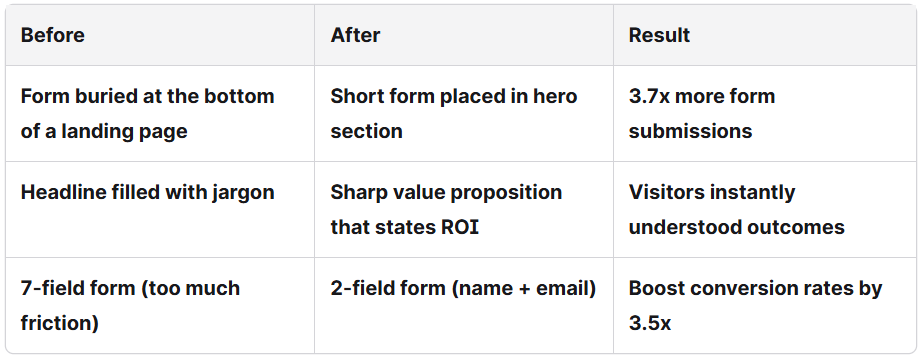
Do this now:
- Move your lead capture to the hero.
- Cut your form down to two fields.
- Tie the headline to ROI, not fluff.
I tested this on a SaaS client with steady web traffic but no qualified leads. In six weeks, they jumped from 34 to 127 leads per month without adding spend.
Why Most Websites Struggle to Convert Visitors into Customers
I’ve seen too many sites that look great and attract steady website visitors, yet the conversion rate stays stuck at 1 or 2 percent. The problem isn’t traffic, it’s structure. Without a sharp value proposition, optimized landing pages, social proof, and the right conversion system, your website conversions won’t grow. In this guide, I’ll show you how to improve your website conversion rate with proven frameworks, real data, and steps you can apply today.
Main Insights: Where Most Sites Go Wrong
- Weak Value Propositions Kill Conversions
- Clever copy confuses the target audience.
- Example: Changing a headline to “Cut Procurement Costs by 37% in 90 Days” doubled engagement.
- Pro Tip: Explain ROI in under 10 words.
- Social Proof Builds Trust Fast
- No one completes a checkout form without proof.
- Add customer testimonials, authentic customer reviews, client logos, and ROI stats.
- Example: Three video testimonials boosted conversion rates by 47 percent.
- Mobile Optimization Is Not Optional
- Over 50 percent of decision makers browse on mobile devices.
- A slow mobile site kills credibility.
- KPI to Track: If mobile bounce rate is 20 percent higher than desktop in Google Analytics, fix your responsive design.
- Content Strategy Must Match the Customer Journey
- Top Funnel: Blogs, guides, white papers that solve pain points.
- Mid Funnel: ROI tools, case studies, demos.
- Bottom Funnel: Clear pricing pages, product descriptions, and CTAs.
- Callout: For each buyer persona, build one piece of content per stage to cover the conversion paths.

Frameworks That Actually Improve Website Conversions
Most teams think they need more traffic to fix a low conversion rate. In reality, the fastest wins come from better structure. Over the years, I’ve built a few proprietary frameworks that consistently turn flat sites into revenue engines.
The Growth Engine Website™
This is the core framework I use to scale website conversions. It has four parts:
- Traffic with Intent
Not all visitors matter. Focus your marketing efforts on traffic that has higher purchase intent. Use google ads, organic traffic, and targeted campaigns to attract the right audience instead of chasing volume. - Conversion Architecture
Every landing page should answer three questions in under 10 seconds: Who is this for? What’s the ROI? What is the next step? If visitors can’t answer these, you will lose them. - Trust Layer
Add social proof such as customer testimonials, client logos, and authentic customer reviews. People buy from those they trust. - Lead Capture and Nurture
Place short forms, CTAs, and live chat in smart locations. Use email to nurture interest into paying customers.
Funnel Gap Analysis™
This framework finds where you are leaking conversions.
- Traffic Stage: Are you attracting the right site visitors from the right traffic channel?
- Engagement Stage: Use analytics tools to see how long people stay on web pages. Are users engaged or bouncing?
- Conversion Stage: Measure form submissions, checkout form, and checkout page drop-offs.
- Revenue Stage: Match macro conversions like sales and sign-ups with micro conversions like clicks, downloads, and trial starts.
When one stage underperforms, your conversion funnel stalls.
Key Web Pages That Drive Conversions
Not every page is equal. Some pages control most of your pipeline.
- Homepage: Needs a clear value proposition, strong CTA, and visible social proof.
- Landing pages: Best for specific campaigns and target audience.
- Product pages: Focus on outcomes, not features. Use high quality images and strong product descriptions.
- Pricing page: Test layouts, tables, and CTAs. Small changes here can double conversion rates.
- Checkout page: Keep forms short. Too many fields frustrate visitors and kill conversions.
Contrarian Insight: Stop Chasing More Traffic
Most leaders want to pour money into ads to increase conversions. But more traffic does not guarantee more pipeline. I’ve seen sites with 50,000 visitors produce fewer leads than sites with 5,000.
The difference is structure. A well-built conversion rate optimization system turns even small volumes of existing traffic into measurable revenue.
KPI Benchmarks That Matter
If you can’t measure it, you can’t fix it. These are the KPIs I track on every project:
- Average conversion rate: 2–3% is common, 5%+ means your site is performing.
- Ecommerce conversion rate: Most ecommerce sites average 1–2%. A good ecommerce conversion rate is 3%+.
- Landing page conversion rates: 2–5% for cold traffic, 6–10% for warm traffic.
- Pricing page conversions: At least 20–30% of visitors should click to trial or demo.
- Checkout form completion: Keep abandonment below 70%. Each field you remove improves the higher conversion rate.

Advanced Tactics to Boost Conversion Rates
Once the basics are in place, the next step is to fine-tune details that often get ignored. These advanced tactics deliver measurable lifts in conversion rates without adding new traffic.
Use Discount Codes the Right Way
A discount code can motivate fence-sitters to act, but only if used carefully. Offer it on the checkout page or through an exit pop-up instead of blasting it everywhere. One ecommerce client added a small discount code on abandoned checkout forms and recovered 18% of lost revenue in a single quarter.
Optimize the Search Feature
Many website visitors use the search bar when they cannot find what they need. If the search function is weak, it will frustrate visitors and lower conversion rates.
- Track what people search for with conversion tracking.
- Place the search feature prominently on key web pages.
- Make sure results lead to product pages or landing pages that can increase conversions.
Improving search often leads to much higher purchase intent actions.
Leverage Micro Conversions and Macro Conversions
Don’t just look at final sales. Strong conversion rate optimization means tracking both:
- Micro conversions: clicks on CTAs, video views, downloads, sign-ups.
- Macro conversions: demos booked, transactions, or new paying customers.
By improving micro conversions, you create momentum that leads to stronger macro conversions. For example, improving email sign-ups by 20% usually boosts website conversions later in the funnel.
Reduce Friction in Checkout Forms
The checkout form and checkout page are where money is won or lost. Every extra step kills your website’s conversion rate.
- Keep it to 3–4 fields maximum.
- Remove distractions from the checkout pages.
- Show trust signals like customer testimonials or authentic customer reviews.
One client reduced a checkout form from 8 fields to 4 and saw a 29% lift in ecommerce conversion.
Understand User Behavior to Guide Decisions
You cannot guess what works. Track user behavior and visitor behavior with heatmaps, scroll maps, and analytics tools.
- See where people drop off in the conversion funnel.
- Collect user feedback to identify friction points.
- Watch how site visitors interact with CTAs and forms.
These actionable insights reveal exactly where to test changes and how to boost conversion rates.
Continuous Improvement Through Testing
There is no finish line in conversion optimization. Top performers test constantly.
- A/B test landing pages, pricing page layouts, and CTAs.
- Experiment with product descriptions and high quality images.
- Monitor page load times and page speed for mobile and desktop.
Each test adds to a culture of continuous improvement that compounds results over time.
Contrarian Insight: Don’t Obsess Over the Average Conversion Rate
Marketers often ask, “Is 7% a good conversion rate?” The truth is, averages hide more than they reveal. A 7% rate might be excellent for one ecommerce website but low for a high-ticket B2B service site.
Instead of chasing benchmarks, focus on your own website data. Measure the lift from every change. The only real goal is to see increasing conversions month after month.

KPI Benchmarks for Advanced Optimization
- Ecommerce conversion rates: 1–2% is average, 3%+ is strong, 5% is elite.
- Micro conversions: 5–10% improvement per test compounds quickly.
- Macro conversions: At least 25% of captured leads should move to the next stage.
- Search bar usage: 20–30% of mobile users and desktop visitors rely on it. A poor search function kills conversions.
- Pricing page performance: At least 20% of visitors should click to trial or demo.
Quick-Reference Summary:
If you remember only a few things from this guide, let it be these:
- A sharp value proposition is the fastest way to lift conversion rates.
- Place CTAs and landing pages where they align with the user journey.
- Use social proof like customer testimonials, authentic customer reviews, and client logos to build trust.
- Keep checkout forms and the checkout page short and simple to reduce friction.
- Track micro conversions and macro conversions to measure progress.
- Optimize for mobile devices, mobile site speed, and mobile users who often have much higher purchase intent.
- Leverage discount codes, search bar, product descriptions, and pricing page testing to continuously boost conversion rates.
- Focus on conversion rate optimization as a system, not a one-time project.
Final Tips for Leaders Driving Conversion Optimization
- Audit your current site: Pretend you are a new visitor. Does the ROI stand out in 5 seconds?
- Tie changes to data: Use analytics tools and conversion tracking to see what actually drives results.
- Focus on reducing friction: Every click, form field, and delay can frustrate visitors.
- Invest in website usability: Strong website usability encourages users to stay longer, interact more, and convert.
- Run continuous improvement tests: Test CTAs, product pages, pricing page layouts, and checkout pages. Small gains add up.
The most successful sites treat conversion optimization as a culture of constant learning, not a single project.
FAQ
How can I increase the conversion rate of my website?
You can increase conversions by clarifying your value proposition, optimizing landing pages, adding social proof, improving your pricing page, and reducing steps in your checkout form. Use conversion rate optimization frameworks and test regularly with real website data.
Why is my website conversion rate so low?
A low conversion rate usually comes from unclear messaging, slow page load times, weak social proof, or poor mobile optimization. It can also be caused by long checkout forms or confusing conversion paths that frustrate visitors. Analyze visitor behavior and use user feedback to find friction points.
Is 7% a good conversion rate?
For most industries, yes. A 7% conversion rate is above average. But remember, a good ecommerce conversion rate is often closer to 3%, while B2B lead-gen sites may convert at 5% or higher. What matters most is whether your changes are increasing conversions over time.
What is a good conversion rate for a website?
The average conversion rate across industries is around 2–3%. Ecommerce conversion rates usually fall between 1–2%, while well-optimized ecommerce sites can reach 3–5% or more. For service-based businesses, anything above 5% is strong. Focus less on the benchmark and more on continuous conversion optimization.

Where Conversions Really Begin
The difference between a site that looks good and one that drives growth is structure. Apply clear value propositions, social proof, responsive design, and buyer-focused content, and your website becomes more than a brochure — it becomes a growth engine. Start small, track the lift in conversions, and keep improving until every change compounds into lasting results.