

The 5 Must-Ask Marketing Manager Interview Questions (Feel Free to Copy):
- How would you define our target audience if you joined tomorrow?
- Describe the overall marketing strategy you would propose for our next 12 months.
- Tell me about your most successful campaign. What made it work?
- Which analytics tools do you use to measure success?
- How do you use the CMO Dashboard Framework™ to track performance?
These five questions have saved me from costly hires that would have drained budget and time. Copy them into your interview note, they work.
Running three digital companies taught me that one hire can change everything. That is why I built an ROI-driven set of marketing manager interview questions to find candidates who can execute marketing strategies, deliver profitable marketing campaigns, and lead a strong marketing team.
Main Insights
- 41 proven manager interview questions tied directly to ROI, pipeline growth, and risk reduction.
- 7 categories that cover strategy, execution, analytics, product marketing, leadership, adaptability, and measurement.
- Clear connections to data and market research and measurable KPIs.
- Contrarian insights learned from previous company hires that stalled growth.
- A shortlist of must-ask interview questions for busy leaders.

Very Important: If you only ask a few questions, make sure they include:
- How would you define our target audience if you joined tomorrow?
- Describe the overall marketing strategy you’d propose for our next 12 months.
- Tell me about your most successful campaign, what made it work?
- Which analytics tools do you use to measure success?
- How do you use the CMO Dashboard Framework™ to track performance?
The 7 Categories Every Marketing Manager Interview Must Cover
Strategy, execution, analytics, product marketing, leadership, adaptability, and measurement.
1. Strategy and Planning: Defining the Target Audience and Market Research
Weak hires always skip the basics. They launch marketing campaigns without fully understanding the target audience or the target market. Strong marketing managers start with clear data and market research and connect every idea back to ROI.
Questions to Ask:
- How would you define our target audience if you joined tomorrow?
- Describe the overall marketing strategy you’d propose for our next 12 months.
- How do you decide which marketing campaigns to prioritize?
- Give an example where your marketing strategy drove measurable growth.
- How do you approach go-to-market planning for a new product launch?
- How do you validate a market opportunity before committing resources to a campaign?
How to Interpret:
Look for market research skills, KPI alignment, and clarity in execution planning. If you hear “brand awareness” without metrics, push for measurable outcomes.
KPI to Track: % of planned campaigns achieving ROI targets.
Do This: Add a scoring note for each question on your interview template.
2. Campaign Execution: Turning Strategy Into Action
A brilliant marketing strategy means nothing without execution. The best marketing managers I have hired were able to launch marketing campaigns fast, adapt when data shifted, and keep campaign objectives tied to ROI. The weak hires let marketing efforts run too long and wasted budget across the wrong marketing channels.
Questions to Ask:
- Tell me about your most successful campaign, what made it work?
- Share a campaign that was marketed poorly, what went wrong?
- Describe how you ensure campaign objectives are met.
- How do you manage campaigns across multiple social media platforms?
- How do you adapt ad creatives for different social media channels?
- What’s your process for reallocating budget mid-campaign to maximize ROI?
How to Interpret:
Strong candidates connect execution directly to ROI, adjust quickly when performance dips, and adapt messaging for each channel. If they skip testing or optimization, ask for examples of iteration.
KPI to Track: Campaign ROI by channel.
Do This: Request before-and-after performance data for at least one campaign they’ve led.
3. Digital Marketing and Analytics: Data Beats Guesswork
The biggest difference between my best and worst hires is simple: the best loved data, the worst relied on instinct. The right marketing manager knows how to grow website traffic, track engagement metrics, and optimize customer retention.
Questions to Ask:
- What’s your experience managing social media marketing campaigns?
- Which analytics tools do you use to measure success?
- How do you optimize website performance for better conversion rates?
- Share a time you improved website traffic through digital marketing and outreach.
- How do you track engagement metrics in email marketing campaigns?
- How do you identify and prioritize the highest-converting audience segments from campaign data?
How to Interpret:
Look for skill with Google Analytics, A/B testing, and translating data into action. If answers rely on “gut feeling,” press for metrics-based decisions.
KPI to Track: Conversion rate improvement after optimization.
Do This: Ask for a sample performance dashboard or analytics report from a previous role.

4. Product Marketing and Go-To-Market: Launches Are Just the Start
Too many teams celebrate “launch day” like it is the finish line. In my companies, real ROI always came during weeks 2 to 8 of refinement.
Questions to Ask:
- How do you generate demand for a product in a competitive market?
- How do you align product marketing with content strategy?
- Share a successful launch story, what was your role?
- How do you integrate sales team feedback into marketing activities?
- Describe your keyword research process before a launch.
- How do you keep your team motivated and engaged during a campaign that’s underperforming?
How to Interpret:
Expect clarity on audience segmentation, cross-team integration, and data-backed adjustments. Avoid hires focused solely on creative without demand-gen metrics.
Contrarian Insight:
Most companies overemphasize “launch day” but miss the post-launch refinement window, where ROI often jumps significantly between weeks 2–8.
KPI to Track: % of launches meeting revenue targets.
Do This: Request a go-to-market plan they’ve led, including post-launch optimization results.
5. Leadership and Team Management: Multipliers, Not Managers
A marketing manager’s impact is not just campaigns but people. My best hires built cross functional teams, coached every team member, and developed strong leadership skills across the group.
Questions to Ask:
- How do you build leadership skills in your marketing team?
- Share a time you promoted a team member.
- How do you lead cross-functional teams in high-pressure situations?
- Describe handling a difficult team dynamic while meeting campaign objectives.
- How do you align the team with the overall marketing strategy?
- What’s the single most impactful KPI you’ve improved, and what steps did you take to achieve it?
How to Interpret:
Look for structured leadership approaches, clear career development pathways, and strong retention rates. Avoid candidates with “sink or swim” leadership styles.
Benchmark to Beat: Top-performing managers in our data maintain an 85%+ retention rate in their first two years.
KPI to Track: Year-over-year team retention rate.
Do This: Ask for real examples of upskilling junior team members and improving overall team performance.
6. Problem Solving and Adaptability: Marketing Never Stays Still
Markets shift, algorithms change, and trends evolve. Strong marketing managers show fast problem solving skills and adapt their marketing tools when performance dips.
Questions to Ask:
- Describe a time you spotted a problem early and fixed it.
- How do you pivot marketing campaigns when the target audience changes?
- What marketing tool have you implemented that improved performance?
- How do you track the latest marketing trends?
- Share a time you shut down a campaign mid-way, why?
How to Interpret:
Top candidates tie pivots to performance data, not hunches. They also demonstrate calculated decision-making when reallocating budget or resources.
Contrarian Insight:
Killing a campaign isn’t failure, it’s an optimization strategy if it redirects budget to higher-ROI activities.
KPI to Track: % of campaigns successfully adapted to meet or exceed targets.
Do This: Add a behavioral interview question that forces candidates to walk you through a past pivot and the results it generated.

7. Measurement and Continuous Improvement: Scaling What Works
One truth I have learned is that what you measure improves. The strongest hires build systems to track key performance indicators and improve results across digital channels and email marketing
Questions to Ask:
- Describe a conflict with a team member and how you resolved it.
- Tell me about influencing leadership without formal authority.
33. Share an example from your previous company where marketing efforts turned around a product. - How do you measure success in multi-channel campaigns?
- How do you balance lead generation and customer retention?
- What’s your first step if campaign objectives are missed?
- What’s the single most impactful KPI you’ve improved, and what specific actions led to that result?
How to Interpret:
Look for comfort with attribution models, KPI tracking, and optimization cycles. Avoid candidates who rely on a single “vanity metric” like CTR without connecting it to revenue.
Benchmark to Beat: Teams with a formalized continuous improvement process achieve a 22% faster ROI cycle.
KPI to Track: % of campaigns improved through iteration.
Do This: Request a sample CMO Dashboard Framework™ they’ve built to track campaign performance.
Why Most Marketing Manager Interviews Fail and Hurt Marketing Efforts
“If your interview questions do not tie to measurable outcomes, you are hiring on guesswork.”
Too many companies still rely on résumés and good vibes in the room. I have seen this mistake cost hundreds of thousands. Without structured, ROI-linked questions, you risk bringing in someone who:
- Talks about marketing strategies but cannot execute them.
- Ignores analytics tools and market research when making decisions.
- Spends heavily on digital channels without increasing website traffic or lead generation.
Case Study from my experience:
A SaaS startup I worked with hired a marketing manager based only on glowing references. Nine months and $420,000 later, there was zero measurable growth. Once we rebuilt the hiring process with structured, ROI-focused manager interview questions, time-to-first-ROI dropped from nine months to just four.
Contrarian Insight: Industry experience is overrated. In my data, execution-focused marketing managers outperform so-called “sector veterans” by 27 percent in ROI growth during the first year.
KPI to Copy: Time-to-first-ROI from a new hire.
Do this: Audit your last marketing manager interview. If fewer than 70 percent of your questions tied to revenue or risk reduction, it is time to redesign your process.
KPI Cheat Sheet for Marketing Manager Interviews
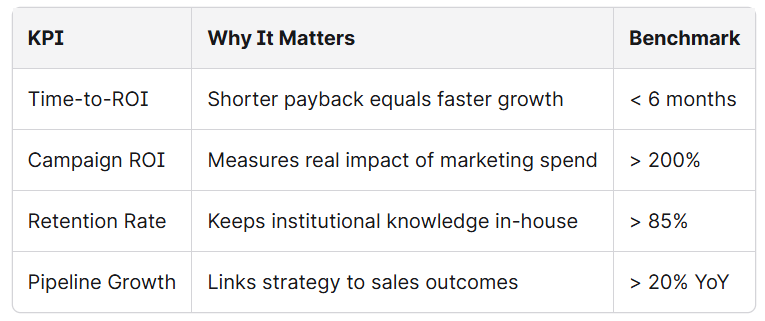
Add these KPIs to your scorecard and rate every candidate against them.
Quick-Reference Shortlist: 10 Must-Ask Marketing Manager Interview Questions
When time is short, these questions reveal the clearest signals of a high-ROI hire:
- How would you define our target audience if you joined tomorrow?
- Describe the overall marketing strategy you’d propose for our next 12 months.
- Tell me about your most successful campaign, what made it work?
- Share a campaign that was marketed poorly, what went wrong?
- Which analytics tools do you use to measure success?
- How do you optimize website performance for better conversion rates?
- How do you generate demand for a product in a competitive target market?
- How do you build leadership skills within your marketing team?
- Describe a time you spotted a problem early and fixed it.
- How do you use the CMO Dashboard Framework™ to track performance?
Do This: Print this list and keep it on hand during interviews.
The Key Role of a Marketing Manager
A top marketing manager drives growth by:
- Executing profitable marketing strategies.
- Leading high-performance marketing teams.
- Using data and market research to guide every decision.
- Optimizing the company website for lead generation.
- Measuring success with the CMO Dashboard Framework™.
Boardroom Takeaway:
A great hire is both a revenue multiplier and a risk reducer.

Final Tips for a High-ROI Hiring Process
- Use structured manager interview questions tied directly to ROI.
- Score every marketing manager candidate with measurable criteria.
- Prioritize execution, adaptability, and data-driven decision-making.
- Keep a shortlist of must-ask questions handy for quick interviews.
Final tip: Do not hire on talk. Hire on evidence.
Ready to Make Your Next Marketing Hire Your Most Profitable Yet?
Book a 30-minute Hiring Strategy Session and learn how to design a proven, ROI-focused hiring process so your next marketing manager delivers measurable results from day one.
Book Your Strategy Session →
Frequently Asked Questions – Marketing Manager Interviews
What’s the main difference between a good and bad marketing manager hire?
A good hire delivers measurable ROI, grows your pipeline, and leads a team that executes strategy effectively. A bad hire drains budget, stalls growth, and forces leadership to spend time fixing problems instead of building momentum.
How should I structure a marketing manager interview?
Organize your questions into four core pillars, Strategy, Execution, Leadership, and Measurement. Make sure every question connects to measurable outcomes like revenue growth or risk reduction, rather than just testing general marketing knowledge.
What are the top skills to look for in a marketing manager?
Look for a balance of strategic planning, multi-channel campaign execution, team leadership, and data-driven decision-making. Candidates should show proficiency with tools like the CMO Dashboard Framework™ to measure and optimize performance.
Which KPIs matter most when evaluating candidates?
Key KPIs include:
- Time-to-first-ROI — the speed at which their work produces measurable returns.
- Campaign ROI — the efficiency and profitability of campaigns they lead.
- Retention rate — their ability to keep top talent on the team.
- Pipeline growth — their direct contribution to sales outcomes.
What red flags should I watch for in a marketing manager interview?
Be cautious if candidates:
- Overemphasize “brand awareness” without tying it to metrics.
- Can’t connect past campaigns to specific ROI results.
- Lack hands-on analytics skills.
- Have no track record of improving team performance or retention.
What’s the single most effective way to ensure a high-ROI hire?
Use structured, ROI-focused questions and score every candidate with clear, measurable criteria. This ensures you separate confident talkers from proven operators who can scale your marketing revenue.